
When Thinking Patterns Shape Self-Worth and Relationships
Did you know Alexis from Schitt’s Creek has some great insights on distorted thinking? Read more below!
Some unhelpful thinking patterns don’t just change how we interpret events. They shape how we see ourselves and how safe we feel taking up space in relationships.
These patterns often develop in environments where needs were minimized, emotions were discouraged, or love felt conditional. They can look adaptive on the surface, but over time they quietly erode self-trust and connection.
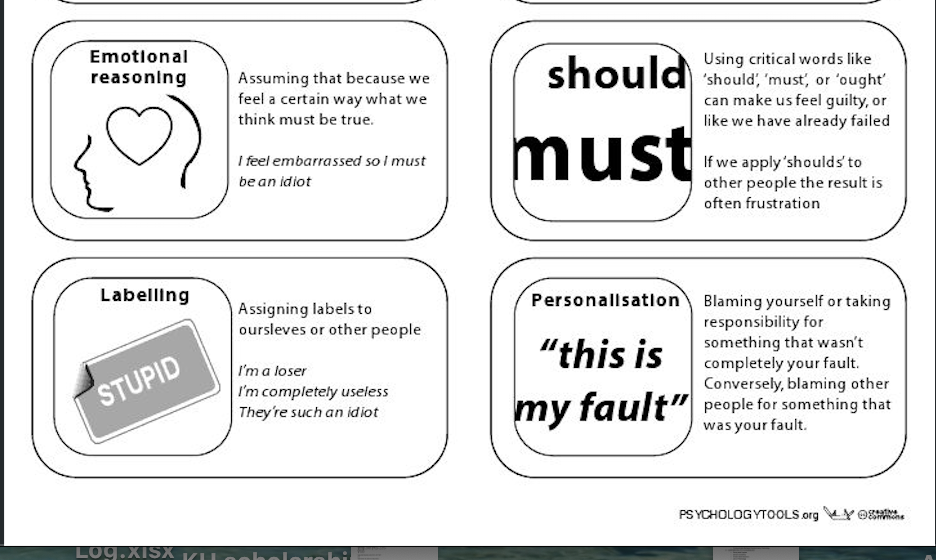
More unhelpful thinking styles (or cognitive distortions) from psychologytools.org
Minimization
Minimization downplays your feelings, needs, or experiences.
Examples:
“It’s not that big of a deal.”
“Other people have it worse.”
This can show up as dismissiveness toward yourself or as fawning behaviors in relationships. While it may reduce conflict in the short term, it often leads to resentment, emotional exhaustion, and a loss of clarity about what you actually need.
Emotional Reasoning
Emotional reasoning treats feelings as facts.
Examples:
“I feel like a burden, so I must be one.”
“This feels wrong, so it must be wrong.”
Emotions carry important information, but they are not objective proof. When feelings become the sole evidence, self-doubt and anxiety tend to grow.
“Should”ing all over ourselves and “Must”erbation
You’ll never forget this one if you think about it that way! This pattern is built around rigid internal rules.
Examples:
“I should be over this by now.”
“They should know what I need.”
These rules often create shame and chronic pressure. They leave little room for human limits, learning curves, or differences. Alexis from Schitt’s Creek says this best: “People aren’t thinking about you the way you think about you.” We get stuck inside our inner worlds, so it’s hard to see outside of our perspectives, especially when fear takes over.
Labeling
Labeling collapses a person into a single word, usually after a mistake or moment of vulnerability.
Examples:
“I’m too much.”
“I’m a failure.”
“He’s useless.”
Labels feel definitive, but they erase context and complexity. Once applied, they shape how future experiences are interpreted.
Personalization
Personalization involves taking responsibility for things that are not actually yours to carry. Or on the flip side, blaming others for something that was not their fault.
Examples:
“They’re upset, it’s all my fault.”
“I caused this.”
Both of these are examples of fawning, a trauma response. This pattern is especially common in people who learned early to monitor others’ emotions in order to feel safe.
“They made me feel this way.” - Not taking responsibility for your own feelings.
“If they hadn’t annoyed me earlier, I wouldn’t have reacted like that.” - This is just defensiveness.
A Compassionate Closing
These thinking patterns often formed for understandable reasons, and shocker, your friendly therapist friend on the other side of the screen is guilty of these too! I hope we can recognize that these thought patterns have helped us stay safe. They helped you cope, stay connected, or avoid harm.
Noticing them is not about blame. It’s about choice. When you can name these patterns, you gain more flexibility in how you respond to yourself and to others.
In future posts, we’ll explore practical ways to work with these thoughts gently and effectively, without trying to silence your brain or force yourself to “think positive.”
Sources and Further Reading
These patterns and their interventions are also grounded in Cognitive Behavioral Therapy (CBT) and related evidence-based approaches. Key resources include:
Beck, A. T. (1976). Cognitive Therapy and the Emotional Disorders. International Universities Press.
Beck, J. S. (2011). Cognitive Behavior Therapy: Basics and Beyond (2nd ed.). Guilford Press.
Burns, D. D. (1980). Feeling Good: The New Mood Therapy. HarperCollins.
Ellis, A., & Harper, R. A. (1997). A Guide to Rational Living. Wilshire Book Company.
Greenberger, D., & Padesky, C. A. (2016). Mind Over Mood (2nd ed.). Guilford Press.
