

The Heated Rivalry Effect: What a Couples Therapist Is Seeing Women Discover About Desire

Photo credit: HBO, Heated Rivalry
Okay, okay- I know the title is a little clickbait. But hear me out.
Unless you've been living under a rock for the past several months, you've probably heard about Heated Rivalry, the breakout queer sports romance series based on Rachel Reid's Game Changers novels. The show follows Shane Hollander and Ilya Rozanov, two rival professional hockey players whose secret relationship unfolds over the course of years.
As a queer woman myself, I devoured the series in a single weekend. More than once I found myself blushing when my partner walked into the room. While Shane and Ilya's romance was captivating, I was especially moved by Scott and Kip's storyline. As someone who has experienced being in a relationship while still closeted, parts of their journey touched something younger inside of me. It felt unexpectedly healing.
But what surprised me even more happened after I finished the show.
I started noticing it in my therapy office.
Without revealing anything about individual clients, I began hearing Heated Rivalry come up organically in conversations. At first, it was from the people I expected- clients that are a part of the LGBTQ+ community. Then I noticed something I hadn't anticipated.
Many women who identify as heterosexual were just as captivated by the series, often even more so.
And while everyone's experience is different, I started noticing a few common themes.
1. Women were reconnecting with desire.
Many described finding themselves more interested in sexuality in general. Some began reading romance novels or "smut" for the first time. Others started looking for stories with similar emotional intensity.
Interestingly, it didn't seem to be just about the explicit content.
It was about longing.
Anticipation.
Emotional intimacy.
Years of unresolved tension.
Watching two people desperately want each other while navigating vulnerability, fear, and connection seemed to awaken something that had been dormant for many viewers.
As a couples therapist, I spend a lot of time talking about desire, not just sexual desire, but the experience of feeling alive, wanted, chosen, and emotionally connected. Those experiences are deeply intertwined.
2. Women were talking about sex more openly.
I also noticed that conversations about sex became easier.
Clients who had previously struggled to discuss intimacy with their partners suddenly had language for what they wanted, or at least curiosity about what they might want.
Some found themselves initiating conversations they had been avoiding for years.
Others realized they had never really explored what felt exciting or emotionally meaningful to them outside of what they believed sex "should" look like.
That kind of curiosity is often the beginning of healthier intimacy.
3. Women began noticing what was missing.
Perhaps the most interesting pattern I observed wasn't an increase in sexual desire, it was an increase in awareness.
Some women began recognizing that what they longed for wasn't simply more sex. It was more passion. More anticipation. More emotional pursuit. More intentionality.
For some, Heated Rivalry served as a mirror. It highlighted aspects of intimacy they realized had quietly faded in their own relationships—not because their relationships were "bad," but because many long-term couples gradually shift into functioning more like teammates than lovers.
Others found themselves becoming curious about their own sexuality in ways they hadn't before. They began asking questions like:
What actually turns me on?
What kind of touch feels good to me?
What do I enjoy outside of what I've always done?
Have I ever really shared those answers with my partner?
As a couples therapist, I see this kind of curiosity as a healthy sign. Curiosity is often the first step toward building a richer intimate relationship.
Why this show?
I don't think Heated Rivalry is successful simply because it's a queer romance.
I think it's successful because it portrays emotional vulnerability in a way we don't often see.
The characters are powerful, competitive, emotionally guarded men who slowly learn to communicate, repair, and prioritize connection over image. The physical chemistry is undeniable, but what keeps viewers invested is the emotional safety they gradually build together.
Ironically, many women may be finding in a relationship between two men the kind of emotional intimacy they've been craving all along.
The Research Actually Supports This
One of the most encouraging findings in relationship research is that couples don't necessarily need to have more sex to improve their intimate relationship, they often need to create more space to talk about it.
A large meta-analysis examining 93 studies and nearly 40,000 individuals found that couples who communicate more openly and effectively about their sexual relationship report higher levels of both relationship satisfaction and sexual satisfaction. Interestingly, the quality of those conversations appeared to matter more than simply how often couples talked about sex.
Other research has found that greater sexual communication is associated with:
higher overall relationship satisfaction
greater sexual satisfaction for both partners
increased orgasm frequency for women
greater comfort expressing sexual preferences and desires
This does not necessarily mean that talking about sex directly causes these outcomes, as much of the research is correlational. However, it does suggest something important: healthy couples tend to create space for honest, vulnerable conversations about intimacy.
And that's what I found so fascinating about the Heated Rivalry phenomenon.
Whether the show itself is the catalyst or simply the conversation starter, I noticed many women beginning to ask questions they had never felt permission to ask before. They became more curious about their own desire, more willing to communicate their preferences, and more aware of areas where passion or playfulness had quietly faded into the background.
What This Means for Relationships
Some partners may understandably wonder why their spouse suddenly seems so invested in a television show.
In my observation, it's usually not because they want a hockey player.
It's because the story reconnects them with something deeply human:
The feeling of longing.
The experience of being pursued.
The vulnerability of being truly seen and desired.
Stories have always helped us discover parts of ourselves. Sometimes they entertain us. Sometimes they challenge us. Sometimes they give us language for experiences we couldn't quite name.
If Heated Rivalry has sparked more conversations about desire, intimacy, and emotional connection in relationships, I don't see that as something to fear.
As a couples therapist, I see it as an invitation.
An invitation to become curious about your own relationship.
To ask yourself, and your partner, not only, "How often are we having sex?" but:
"Do we still pursue each other?"
"Do we feel emotionally safe with one another?"
"Do we feel chosen?"
Because those questions are often where deeper intimacy begins.
References
Byers, E. S. (2011).
Beyond the birds and the bees and was more than sex: The importance of sexual communication in intimate relationships. Canadian Psychology/Psychologie canadienne, 52(1), 24–32.
https://doi.org/10.1037/a0022046
Mallory, A. B., Stanton, A. M., & Handy, A. B. (2019).
Couples’ sexual communication and sexual satisfaction: A meta-analysis. Social Psychological and Personality Science, 10(4), 471–483.
https://doi.org/10.1177/1948550618764635

What Mr. Robot Gets Right About Internal Family Systems (IFS)

Okay. Go ahead and judge me for watching Mr. Robot for the first time... ten years after everyone else.
I know.
Somehow this one slipped by me, and now I completely understand why people rave about it.
I loved the writing. I loved the cinematography. I loved the social commentary. But there was one thing I couldn't stop thinking about while I watched it.
This show is one of the best examples of Internal Family Systems, or IFS, that I've seen on television.
So, if it wasn't obvious...
Spoilers ahead.

If you've never heard of IFS, here's the quick version.
IFS is based on the idea that we all have different "parts" of ourselves. We aren't just one unified personality moving through the world. Instead, we have different parts that developed over time to help us navigate life. Have you ever caught yourself saying, "Part of me wants to go to the party, but part of me wants to stay home," or "Part of me wants to leave this relationship, but another part wants to stay"? Most of us talk this way without even realizing it. Parts work basically says all of those parts can exist at the same time. They each have their own perspective, fears, and goals. Sometimes they work together. Sometimes one part grabs the steering wheel and takes on more control than it was ever meant to have. That is usually when people end up in therapy.
Some of those parts are Managers. They're proactive. They try to stay one step ahead of pain by keeping us in control. They're the perfectionists, the planners, the people pleasers, the overthinkers. Their whole job is to make sure we never get hurt in the first place.

Then there are Firefighters.
Firefighters show up after something painful has already been activated. They're less concerned with long-term consequences and more concerned with putting out the emotional fire as quickly as possible. Sometimes that looks like dissociating. Sometimes it's drinking. Sometimes it's binge eating, shutting down, raging, scrolling for hours, or any number of behaviors that help us escape overwhelming emotions.

Neither Managers nor Firefighters are bad.
They're protectors.
And protectors exist because they're trying to keep us away from our most vulnerable parts.
IFS calls those vulnerable parts Exiles. These are often younger parts of us that carry trauma, shame, grief, fear, loneliness, or other experiences that once felt too overwhelming to process.
The goal of therapy isn't to get rid of any of these parts.
It's to help them trust that they don't have to work so hard anymore.
That brings me back to Mr. Robot.
One of the biggest reveals in the show is that Mr. Robot isn't actually a separate person.
He's a part of Elliot.
From an IFS perspective, that makes a lot of sense.
Elliot experiences significant childhood trauma and eventually loses his father after a long illness. His mind creates a protector modeled after the father he needed. Mr. Robot becomes bold when Elliot feels powerless. Confident when Elliot feels afraid. Decisive when Elliot freezes.
He's doing exactly what protectors do.
He's trying to help Elliot survive.
What I found especially interesting is how blended Elliot becomes with Mr. Robot.
In IFS, we use the word blending when a part takes over so completely that we experience the world entirely through that part. Instead of noticing, "A scared part of me is here," we become the scared part.
Or in Elliot's case, we experience that part as an entirely separate person.
Throughout the series, Elliot and Mr. Robot constantly argue. They fight over decisions. They hide things from each other. They each believe they're protecting the system in the right way.

Honestly, I couldn't help but smile.
Not because Elliot's suffering is entertaining, but because the writers found such a creative way to externalize something that all of us experience internally.
Maybe your perfectionistic part wants to keep working.
Another part wants to rest.
One part wants to trust someone.
Another part says absolutely not.
Most of us have these internal conversations every day. They just don't usually look as dramatic as Elliot's.
Some of my favorite scenes are actually Elliot's therapy sessions.
Again and again, we're reminded that the parts causing the most disruption are usually protecting something much more vulnerable underneath.
That's something I spend a lot of time talking about with clients.
People often come into therapy wanting to get rid of their anxiety.
Or their anger.
Or the part that keeps sabotaging relationships.
Or the part that won't stop people pleasing.
I get it.
Those parts can be exhausting.
But IFS asks a different question.
What if that part has been working incredibly hard to protect you?
That doesn't mean we excuse harmful behaviors.
It doesn't mean every protective strategy is healthy.
It simply means we get curious before we judge.
By the end of the series, Elliot starts seeing Mr. Robot differently.
He stops seeing him as the enemy.
He begins recognizing everything Mr. Robot has done to help him survive.
That's one of my favorite parts of IFS.
Healing isn't about getting rid of our protectors.
It's about unblending from them while also appreciating why they showed up in the first place.
When our parts realize they don't have to carry the entire burden alone anymore, they often soften on their own.
For me, that's what Mr. Robot gets so right.
The parts of us that create the most chaos are often the parts that have been trying the hardest to protect us.
Sometimes they just need someone to finally understand what they've been protecting all along.
References
Schwartz, R. C. (2021). No Bad Parts: Healing Trauma and Restoring Wholeness with the Internal Family Systems Model. Sounds True.
Schwartz, R. C., & Sweezy, M. (2020). Internal Family Systems Therapy (2nd ed.). Guilford Press.
Esmail, S. (Creator). (2015–2019). Mr. Robot [TV series]. Universal Cable Productions.
When Thinking Patterns Shape Self-Worth and Relationships

Did you know Alexis from Schitt’s Creek has some great insights on distorted thinking? Read more below!
Some unhelpful thinking patterns don’t just change how we interpret events. They shape how we see ourselves and how safe we feel taking up space in relationships.
These patterns often develop in environments where needs were minimized, emotions were discouraged, or love felt conditional. They can look adaptive on the surface, but over time they quietly erode self-trust and connection.
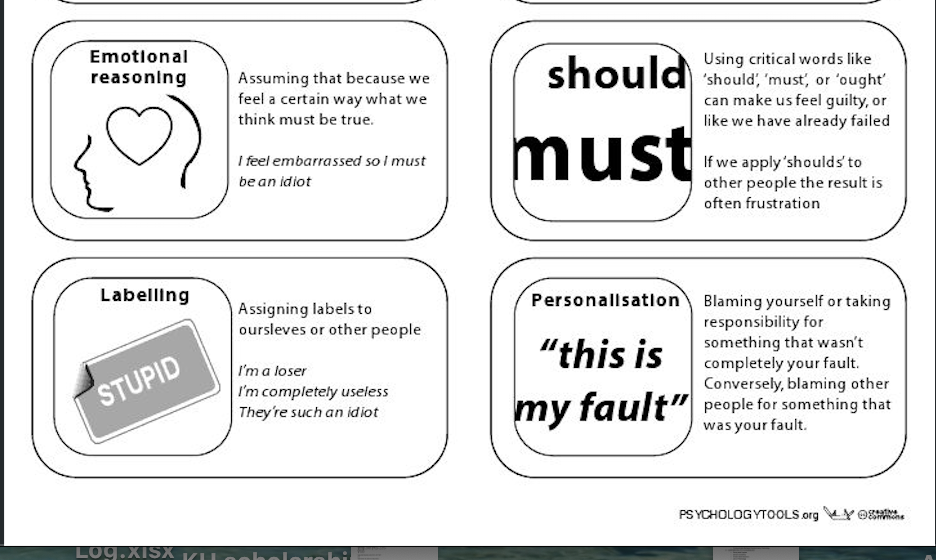
More unhelpful thinking styles (or cognitive distortions) from psychologytools.org
Minimization
Minimization downplays your feelings, needs, or experiences.
Examples:
“It’s not that big of a deal.”
“Other people have it worse.”
This can show up as dismissiveness toward yourself or as fawning behaviors in relationships. While it may reduce conflict in the short term, it often leads to resentment, emotional exhaustion, and a loss of clarity about what you actually need.
Emotional Reasoning
Emotional reasoning treats feelings as facts.
Examples:
“I feel like a burden, so I must be one.”
“This feels wrong, so it must be wrong.”
Emotions carry important information, but they are not objective proof. When feelings become the sole evidence, self-doubt and anxiety tend to grow.
“Should”ing all over ourselves and “Must”erbation
You’ll never forget this one if you think about it that way! This pattern is built around rigid internal rules.
Examples:
“I should be over this by now.”
“They should know what I need.”
These rules often create shame and chronic pressure. They leave little room for human limits, learning curves, or differences. Alexis from Schitt’s Creek says this best: “People aren’t thinking about you the way you think about you.” We get stuck inside our inner worlds, so it’s hard to see outside of our perspectives, especially when fear takes over.
Labeling
Labeling collapses a person into a single word, usually after a mistake or moment of vulnerability.
Examples:
“I’m too much.”
“I’m a failure.”
“He’s useless.”
Labels feel definitive, but they erase context and complexity. Once applied, they shape how future experiences are interpreted.
Personalization
Personalization involves taking responsibility for things that are not actually yours to carry. Or on the flip side, blaming others for something that was not their fault.
Examples:
“They’re upset, it’s all my fault.”
“I caused this.”
Both of these are examples of fawning, a trauma response. This pattern is especially common in people who learned early to monitor others’ emotions in order to feel safe.
“They made me feel this way.” - Not taking responsibility for your own feelings.
“If they hadn’t annoyed me earlier, I wouldn’t have reacted like that.” - This is just defensiveness.
A Compassionate Closing
These thinking patterns often formed for understandable reasons, and shocker, your friendly therapist friend on the other side of the screen is guilty of these too! I hope we can recognize that these thought patterns have helped us stay safe. They helped you cope, stay connected, or avoid harm.
Noticing them is not about blame. It’s about choice. When you can name these patterns, you gain more flexibility in how you respond to yourself and to others.
In future posts, we’ll explore practical ways to work with these thoughts gently and effectively, without trying to silence your brain or force yourself to “think positive.”
Sources and Further Reading
These patterns and their interventions are also grounded in Cognitive Behavioral Therapy (CBT) and related evidence-based approaches. Key resources include:
Beck, A. T. (1976). Cognitive Therapy and the Emotional Disorders. International Universities Press.
Beck, J. S. (2011). Cognitive Behavior Therapy: Basics and Beyond (2nd ed.). Guilford Press.
Burns, D. D. (1980). Feeling Good: The New Mood Therapy. HarperCollins.
Ellis, A., & Harper, R. A. (1997). A Guide to Rational Living. Wilshire Book Company.
Greenberger, D., & Padesky, C. A. (2016). Mind Over Mood (2nd ed.). Guilford Press.
When Your Brain Fills in the Blanks
Interpretation-Based Thinking Patterns
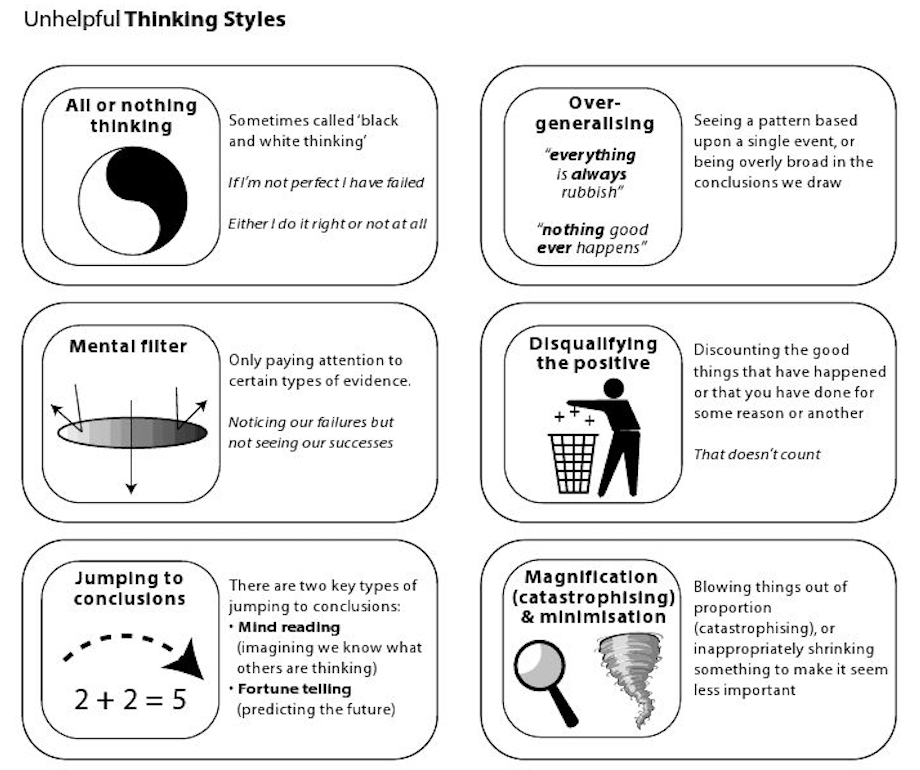
In the last post, I introduced some of the most common unhelpful thinking patterns I see in therapy. Today, I want to slow down and focus on a specific group of them: the ones that shape how we interpret situations, often before we even realize we’re doing it.
These patterns tend to show up when we are stressed, hurt, anxious, or trying to protect ourselves from disappointment. The situation itself may be neutral or ambiguous, but our brain rushes in to explain it, usually in ways that increase distress rather than reduce it.
Let’s look at a few of the most common ones.
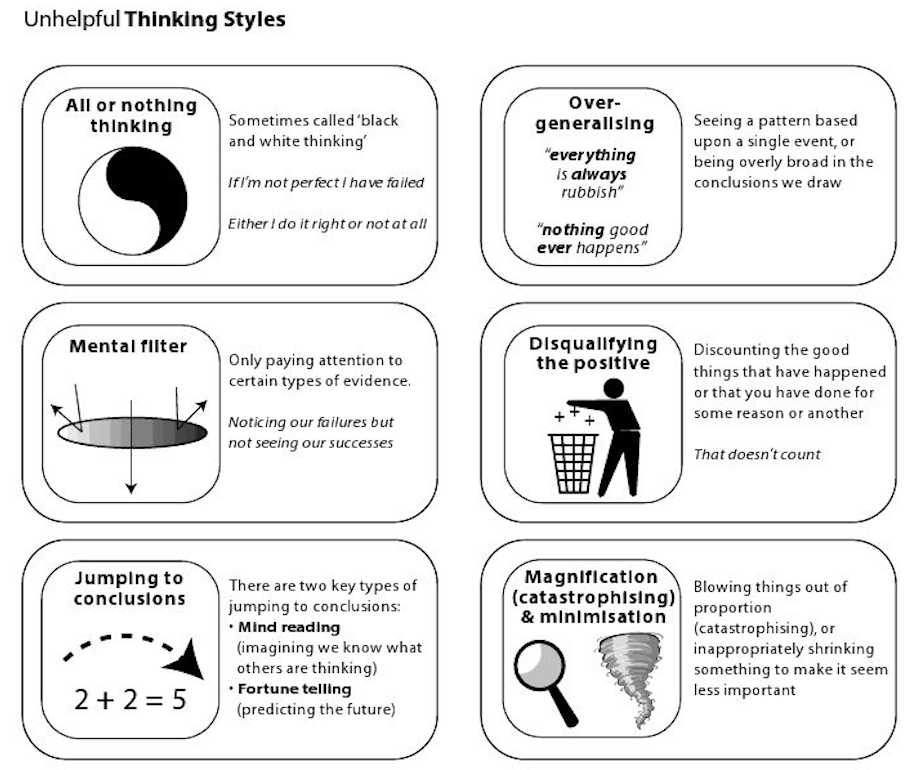
Unhelpful thinking styles (or cognitive distortions) from psychologytools.org
Black-and-White Thinking
Black-and-white thinking leaves no room for complexity. Something is either good or bad, right or wrong, a success or a failure.
In relationships, this can sound like:
“If they really cared, they wouldn’t have done this.”
“If I mess this up, it means I’m not good enough.”
This pattern often develops as a way to create certainty. The problem is that real life and real people are rarely that simple. When we loosen these extremes, we create space for growth, repair, and nuance.
Overgeneralization
Overgeneralization takes one moment and turns it into a rule.
Examples:
“This always happens to me.”
“I never say the right thing.”
The brain uses past pain to predict the future, even when the evidence is limited. One experience becomes a global conclusion about who you are or what to expect.
Mental Filter
A mental filter causes us to fixate on one negative detail while ignoring the rest of the picture.
For example, you might receive mostly positive feedback, but one critical comment becomes the only thing you can think about. The brain treats it as the most important data point, even if it’s not representative.
Over time, this can create a distorted sense of reality that feels far more negative than it actually is.
For many people, mental filters are closely tied to deeper core beliefs or long-standing narratives about themselves or others. If someone carries a belief like “I am unlovable,” moments of rejection or distance will stand out vividly, while moments of care are minimized or explained away. If the underlying narrative is “People can’t be trusted,” the brain will naturally scan for evidence of disappointment or betrayal and filter out experiences of reliability. For me personally, some of my harmful core beliefs are “I am too much” and “I am a bad person,” so I am extra sensitive to feedback or experiences that fit this narrative.
In this way, mental filters do not just shape what we notice. They quietly reinforce the stories we already believe to be true.
Disqualifying the Positive
Disqualifying the positive happens when good things are automatically dismissed.
Examples:
“They’re just being nice.”
“That doesn’t really count.”
This pattern often protects against disappointment, but it also prevents positive experiences from landing. Affirmation, success, and connection are filtered out before they can register.
Jumping to Conclusions
This includes mind reading and predicting the future without enough information.
Examples:
“They haven’t responded, so they must be upset with me.”
“This conversation is going to go badly.”
Our brains are excellent at creating stories, especially when uncertainty feels uncomfortable. Unfortunately, these stories are often convincing and wrong.
A Gentle Reframe
Interpretation-based thinking patterns are not about being irrational. They are about speed. Your brain is trying to protect you by filling in the blanks quickly.
The work is not to stop thoughts from appearing, but to slow them down just enough to ask, “What else might be true?”
In the next post, we’ll look at thinking patterns that impact self-worth and relationships more directly, especially the ones that shape how we see ourselves in connection with others.
Sources and Further Reading
The concepts in this post draw primarily from Cognitive Behavioral Therapy (CBT) and related cognitive models. The following resources are foundational and commonly referenced in both clinical practice and self-help contexts:
Beck, A. T. (1976). Cognitive Therapy and the Emotional Disorders. International Universities Press.
Beck, J. S. (2011). Cognitive Behavior Therapy: Basics and Beyond (2nd ed.). Guilford Press.
Burns, D. D. (1980). Feeling Good: The New Mood Therapy. HarperCollins.
Greenberger, D., & Padesky, C. A. (2016). Mind Over Mood (2nd ed.). Guilford Press.
• Beck, A. T., Freeman, A., & Davis, D. D. (2004). Cognitive Therapy of Personality Disorders (2nd ed.). Guilford Press.

The Unhelpful Thinking Patterns I See Most Often in Therapy
Let me paint a picture for you. It’s a Sunday afternoon. I usually do most of the driving because my partner drives a lot for work. I happily take this on as an act of service in our relationship. On this particular day, I’m driving us to the movies. This was back when I-285 was going through major construction, and I missed our exit… not once, but twice.

In that moment, a voice in my head said, “Well, if he just drove us every once in a while, this wouldn’t have happened.” I literally put on the metaphorical brakes. Where did that come from? This is a perfect example of a cognitive distortion called personalization. I was blaming him for something that was entirely my fault, simply because I wanted to deflect some of the embarrassment and discomfort I felt.
These moments happen to all of us. Our brains are wired to make quick sense of situations, often by shifting blame, amplifying negatives, or filling in the blanks with stories. Recognizing these distortions is the first step in noticing them in your own thoughts and learning to respond differently.
In my last post, we talked about how relationships can get stuck when we assume negative intent instead of giving the benefit of the doubt. That same dynamic shows up not just between partners, but inside our own minds. Many of the struggles clients bring into therapy are not caused solely by what happened, but by the meaning their brain automatically assigns to it.
These patterns are not signs that something is “wrong” with you. They are very human shortcuts our brains use to make sense of the world, especially when we are stressed, hurt, anxious, or overwhelmed. The problem is that these shortcuts often backfire, increasing distress and narrowing our options for responding.
Below are some of the most common unhelpful thinking patterns I see in my work with clients.
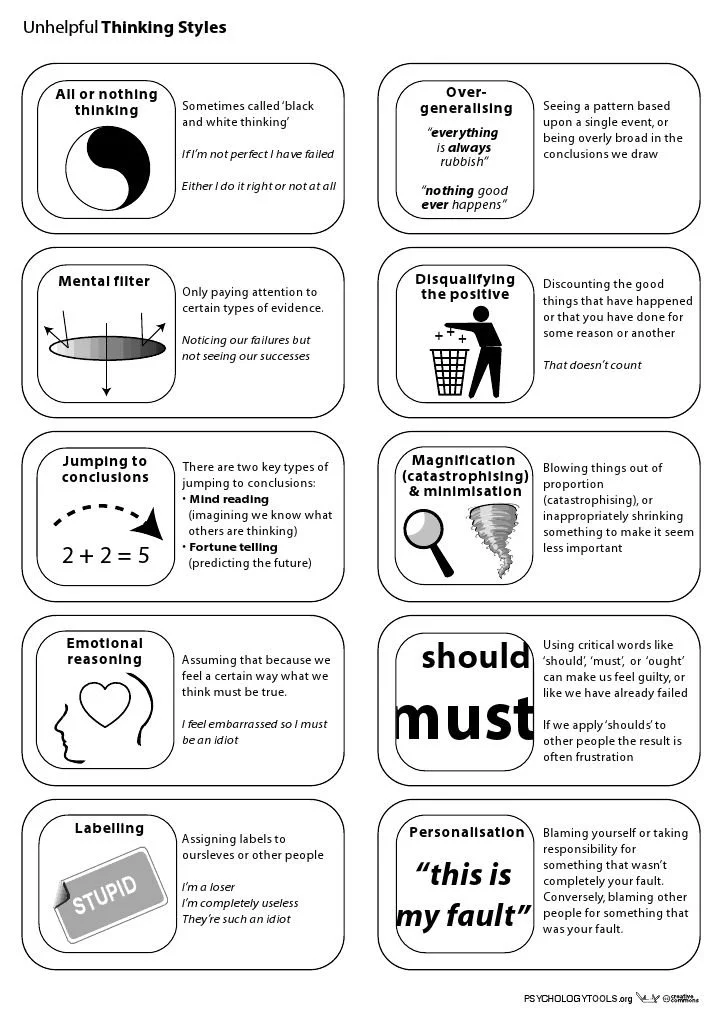
Quick cheat sheet on cognitive distortions, or unhelpful thinking styles.
Black-and-White Thinking, or All or Nothing Thinking
This is the tendency to see things in extremes, with no middle ground. Something is all good or all bad, a success or a failure, loving or rejecting.
Examples:
“If I’m not doing it perfectly, I’m failing.”
“If they really loved me, they would never forget this.”
Real life usually lives in the gray. When we force situations into extremes, we miss nuance, growth, and repair.
Overgeneralization
This happens when we take one experience and apply it broadly, often using words like always, never, or every time.
Examples:
“This always happens to me.”
“I never get it right.”
One moment becomes a sweeping conclusion about who you are or how the world works.
Mental Filter
With a mental filter, the brain zooms in on one negative detail and ignores everything else.
Example:
You receive ten positive comments and one critical one, and the critical comment is all you can think about.
This filter can make life feel far more negative than it actually is.
Disqualifying the Positive
This pattern goes a step further than a mental filter. Even when something positive happens, the brain finds a way to dismiss it.
Examples:
“They’re just being nice.”
“That doesn’t really count.”
Over time, this erodes self-worth and makes it very hard to take in support or affirmation.
Jumping to Conclusions
This includes mind reading and predicting the future without enough evidence.
Examples:
Mind reading: “They didn’t text back, so they must be mad at me.”
Fortune telling: “This conversation is going to go terribly.”
Our brains are excellent storytellers, but not always accurate ones.
Magnification (Catastrophizing)
Here, the brain blows things out of proportion and jumps straight to worst-case scenarios.
Examples:
“This mistake is going to ruin everything.”
“If this doesn’t work out, I’ll never recover.”
Catastrophizing creates intense anxiety and urgency, even when the actual risk is manageable.
Minimization
Minimization downplays needs, feelings, or experiences, often to keep the peace or avoid conflict. This can show up as dismissiveness toward oneself or as fawning behaviors.
Examples:
“It’s not that big of a deal.”
“Other people have it worse, so I shouldn’t complain.”
While it may feel selfless, chronic minimization often leads to resentment and burnout.
Emotional Reasoning
Emotional reasoning treats feelings as facts.
Examples:
“I feel like a burden, so I must be one.”
“This feels unsafe, so it must be unsafe.”
Feelings are real and important, but they are not always reliable evidence.
‘Shoulding’ and ‘Musterbation’
This pattern is built around rigid rules for yourself or others.
Examples:
“I should be over this by now.”
“They must always handle things the right way.”
These internal rules often create shame, pressure, and chronic dissatisfaction.
Labeling
Labeling reduces a whole person, often yourself, to a single word based on behavior or mistakes.
Examples:
“I’m a failure.”
“They’re selfish.”
Labels feel definitive, but they erase context, complexity, and the possibility of change.
Personalization
Personalization involves taking responsibility for things that are not actually about you.
Examples:
“They’re quiet today, I must have done something wrong.”
“This is my fault.”
This pattern can create unnecessary guilt and anxiety, especially in relationships.
A Gentle Reminder
These thinking patterns are not flaws. They are habits, and habits can be noticed, challenged, and softened. Awareness is the first step. When you start to recognize these patterns in your own thoughts, you create space to ask different questions, consider alternative explanations, and respond with more flexibility and compassion.
In upcoming posts, I’ll break these down further and talk about practical ways to work with them, not by arguing with your brain, but by understanding it.
If you recognized yourself in several of these, you’re not alone. This is the work, and we’re all guilty of these!
Sources and Further Reading
If you’d like to learn more about these thinking patterns, the following books and resources are foundational and widely used in therapy:
Beck, A. T. (1976). Cognitive Therapy and the Emotional Disorders. International Universities Press.
Burns, D. D. (1980). Feeling Good: The New Mood Therapy. HarperCollins.
Beck, J. S. (2011). Cognitive Behavior Therapy: Basics and Beyond (2nd ed.). Guilford Press.
Greenberger, D., & Padesky, C. A. (2016). Mind Over Mood (2nd ed.). Guilford Press.
Ellis, A., & Harper, R. A. (1997). A Guide to Rational Living. Wilshire Book Company.
These concepts are core components of Cognitive Behavioral Therapy (CBT) and related evidence-based approaches used to help clients notice, challenge, and soften unhelpful thought patterns.

The Importance of Giving the Benefit of the Doubt in Relationships
I see this all the time in my work with couples. One partner gets hurt, sometimes deeply, by something their partner did or didn’t do, and from that point forward, they start to interpret almost everything through that hurt. A forgotten text becomes “You don’t care about me.” A quiet moment becomes “You’re pulling away again.” A disagreement turns into “You never listen to me.”
These interpretations make sense when we understand that the nervous system remembers pain. Once someone has been hurt, it feels safer to assume threat than to risk being blindsided again. But over time, this protective stance can start to filter how we see our partner and their intentions. That’s where the practice of giving the benefit of the doubt becomes so powerful.

What does benefit of the doubt mean for relationships? Let’s dive deeper!
Positive Perspective vs. Negative Sentiment Override
In John and Julie Gottman’s research, they describe two emotional climates that shape how couples interpret each other’s behavior: positive perspective and negative sentiment override.
When we’re in a positive perspective, we naturally see our partner through a lens of goodwill. If they seem distracted, we might think, “They must be stressed,” instead of “They’re ignoring me.” We assume they care, even if their delivery isn’t perfect.
When a relationship has slipped into negative sentiment override, that lens shifts. Even neutral or kind gestures can start to feel loaded. “Thanks for doing the dishes” might be heard as sarcasm. A simple question might sound like criticism. It’s not that the partner has suddenly become the enemy, it’s that the brain has started to expect disappointment or rejection, and it finds evidence to match that story.
Why It Matters
When we assume good intent, we send a powerful message: “I believe you’re on my side.” That trust helps both people feel emotionally safe, which makes it easier to regulate, repair, and reconnect.
When we assume bad intent, even unconsciously, we activate a threat response. We become guarded, more critical, or withdrawn. That defensiveness often triggers more defensiveness in return, which deepens the disconnect.
Neuroscience supports this pattern. When couples feel misunderstood or unsafe, their stress response stays active (Coan & Sbarra, 2015). The brain moves into protection mode, making it harder to access empathy and curiosity. Choosing to give the benefit of the doubt helps interrupt that cycle. It’s a way of saying, “Let’s slow down. Maybe there’s another explanation here.”
Practicing the Benefit of the Doubt
This doesn’t mean excusing hurtful behavior or pretending things don’t bother you. It means starting from trust instead of assumption. Here are a few ways to practice:
Notice your story. When you feel hurt or frustrated, ask yourself, “What story am I telling myself about why this happened?”
Ask for clarity instead of assuming intent. Try, “Hey, that comment stung a bit. Can you tell me what you meant?”
Remember the bigger picture. If your partner is usually kind or attentive, it’s likely this moment is an exception, not the rule.
Return to shared goals. Remind yourself that you’re on the same team, even when you’re in conflict.
Like any habit, this takes practice, especially if you’ve experienced betrayal or emotional injuries in the past. But over time, giving your partner the benefit of the doubt helps rewire how your brain perceives safety and connection in the relationship.
The Bottom Line
Healthy relationships aren’t built on perfection. They’re built on the ability to interpret each other’s imperfections with generosity. When you assume your partner’s intentions are good, even when they fall short, you strengthen the foundation of trust and care that holds everything else together.
When both partners do this consistently, it creates what the Gottmans call a positive sentiment override, a sense of goodwill that helps you weather conflict with more grace and understanding.
In my next post, I’ll talk about the cognitive distortions that often get in the way of this process and how to recognize when your brain is filling in the blanks with fear instead of fact.
References
Gottman, J. M., & Silver, N. (2015). The Seven Principles for Making Marriage Work. Harmony Books.
Gottman, J. M. (1994). Why Marriages Succeed or Fail: And How You Can Make Yours Last. Simon & Schuster.
Coan, J. A., & Sbarra, D. A. (2015). Social Baseline Theory: The social regulation of risk and effort. Current Opinion in Psychology, 1, 87–91.
The Gottman Institute. (n.d.). Understanding Positive vs. Negative Sentiment Override.
•Fredrickson, B. L. (2001). The role of positive emotions in positive psychology: The broaden-and-build theory of positive emotions. American Psychologist, 56(3), 218–226.
The One Skill I’d Teach Every Couple
My dad once asked me, “What is one thing you would teach every couple in the world?” The answer came to me right away: emotion regulation and validating responses.
These two skills are the foundation of healthy communication and relationship repair. Without them, couples often get stuck in cycles of defensiveness, misunderstanding, or escalation. With them, even tough conversations can feel safer and more productive.
Why Emotion Regulation Matters
When we’re emotionally overwhelmed, our nervous system goes into survival mode. John Gottman refers to this as flooding, a physiological state where our heart rate spikes, stress hormones surge, and our brain struggles to process information clearly (Gottman, 1999).

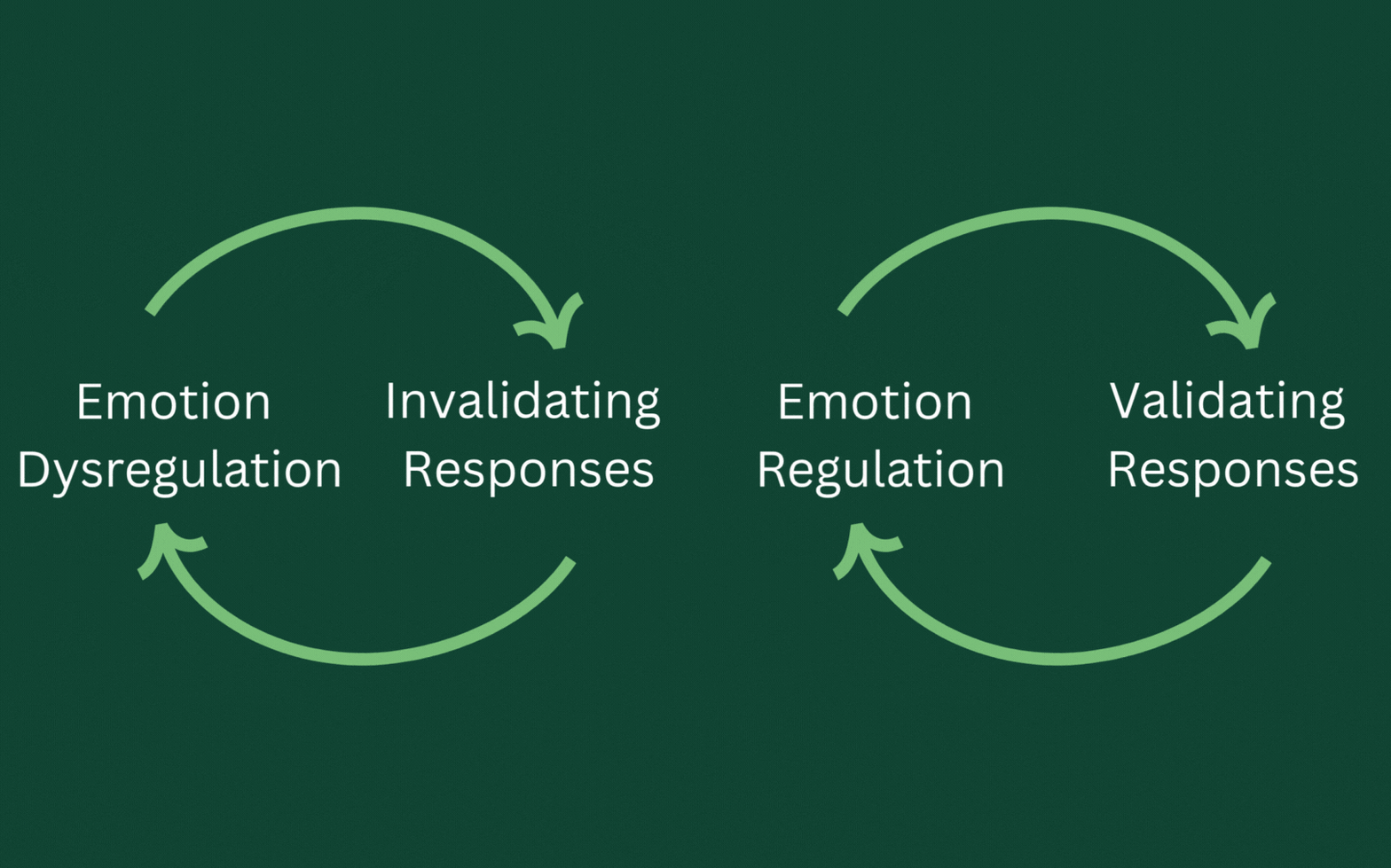
I know, I know. It’s easy to point the finger at our partner. This kind of invalidating response only leads to more emotional dysregulation. This gets us nowhere, but it’s so natural for us to be defensive.
When we’re flooded, we’re far more likely to lash out, shut down, or misinterpret our partner’s words. This is why emotion regulation is crucial. It doesn’t mean ignoring or suppressing emotions, but rather staying grounded enough to choose how to respond, rather than letting our emotions choose for us.
Examples of emotion regulation might look like:
Taking a pause before responding.
Noticing your body cues (tension, racing thoughts, clenched jaw) and calming yourself with a breath or break.
Reminding yourself, “I can slow this down. I don’t need to win, I need to connect.”
The Power of Validation
Once we’re regulated, we can turn to the second skill: validation.
Validation is not about agreeing with your partner, but about acknowledging their experience. It’s saying, “I hear you, I see why you feel that way, and your emotions make sense.”
This step can’t be skipped- when people feel invalidated, they often push harder to be understood, which escalates conflict. But when someone feels heard, the intensity often lowers, and real problem-solving becomes possible.
For example:
Instead of: “You’re overreacting. It’s not a big deal.”
Try: “I can see this really matters to you. That makes sense, you want to feel considered.”
Putting It Together
In my work with couples, I often share a diagram (see below) that illustrates these two pieces: regulation and validation. When both partners learn these skills, conflicts feel less like battles and more like opportunities for connection.
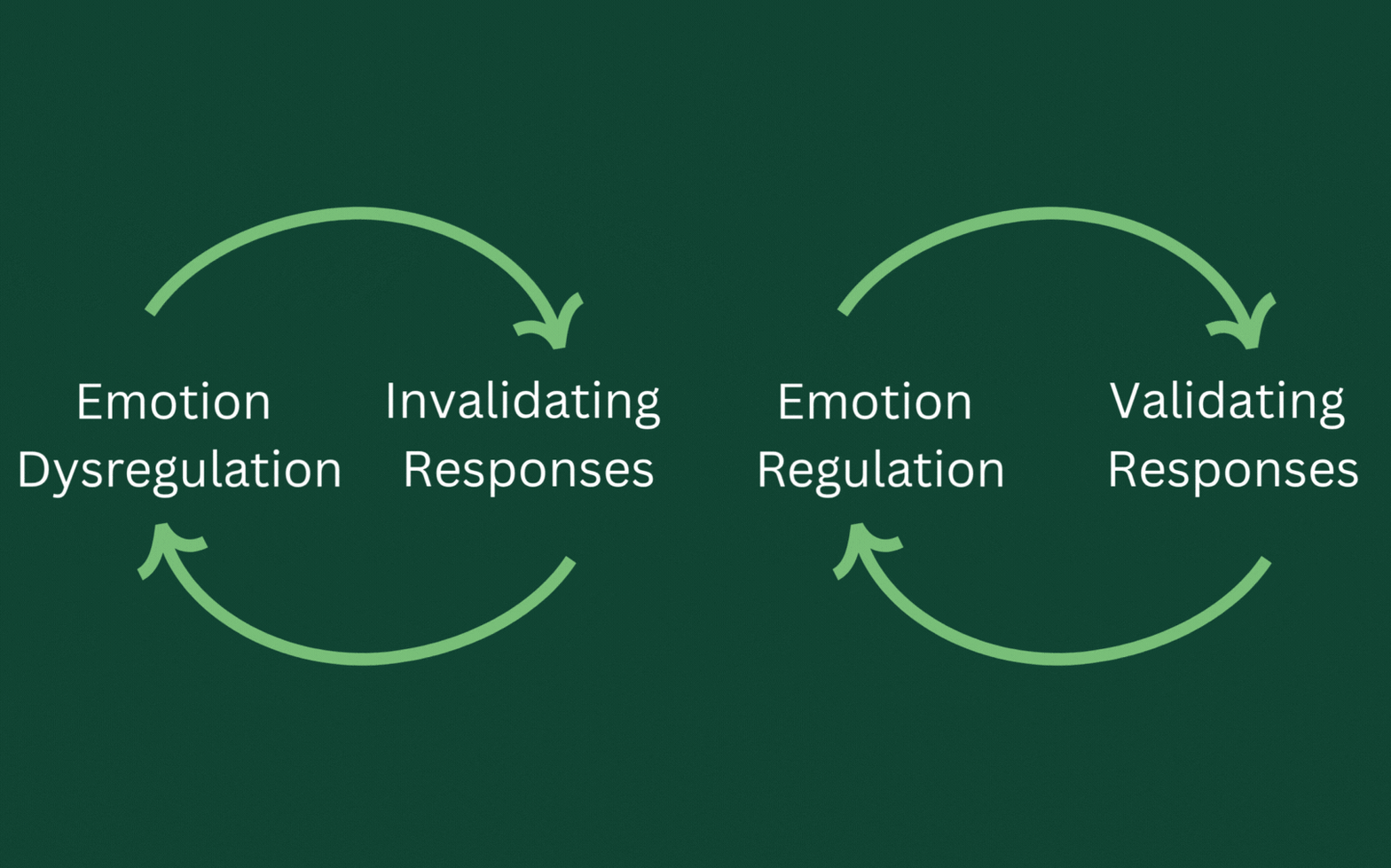
The image shows the two cycles described by Daniel Frezetti, how emotion dysregulation and invalidating responses is a cycle, juxtaposed with emotion regulation and validating responses being it’s own cycle.
As Daniel J. Frezetti describes in The High Conflict Couple, practicing regulation and validation can transform patterns of criticism, defensiveness, and withdrawal into moments of understanding and repair (Frezetti, 2006).
A Gentle Reminder
These skills aren’t about perfection; they’re about progress. No one regulates or validates perfectly every time. But each effort to pause, calm yourself, and validate your partner builds trust and safety in the relationship.
If there’s one thing I wish every couple in the world could practice, it’s this: regulate your emotions, and then respond with validation. That’s where lasting connection begins.
References
Frezetti, D. J. (2006). The High Conflict Couple: A Dialectical Behavior Therapy Guide to Finding Peace, Intimacy, and Validation. New Harbinger Publications.
•Gottman, J. M., & Silver, N. (1999). The Seven Principles for Making Marriage Work. Crown.

Why I Tell Couples To Overcommunicate
The key to conflict management - “overcommunication.”
Lately, I find myself giving couples the same simple but powerful piece of advice in couples counseling: overcommunicate.
Now, I don’t mean flooding your partner with every fleeting thought or texting them a minute-by-minute play-by-play of your day. What I do mean is leaning into direct, proactive communication about both the small and the big things. Overcommunication helps reduce misunderstandings, build trust, and create a stronger foundation for navigating conflict.
The Problem With "Normal" Communication
Many couples come into therapy telling me, “We already communicate- we just don’t get anywhere.” Often, the issue isn’t a lack of talking, but the style of communication. People assume their partner can “read between the lines” or that unspoken needs should be obvious. But research consistently shows that mind-reading in relationships doesn’t work (Gottman & Silver, 1999). Without clarity, assumptions creep in, and those assumptions can breed resentment.
That’s where overcommunication becomes essential. By stating things plainly and proactively, couples remove the guesswork.
Process vs. Content in Conflict
When couples argue, most of the focus tends to land on the content: the dishes in the sink, how money is being spent, how much time is spent with in-laws. Content matters, but what often derails a conflict is the process - the how of the communication.
Do you raise your voice? Shut down? Interrupt? Avoid the conversation altogether? These patterns, left unaddressed, can be more damaging than the content of the disagreement itself. Overcommunicating means naming the process in real time:
“I’m starting to feel defensive- I need a pause.”
“Can we slow this down? I want to really hear you.”
“I think I misunderstood what you just said. Can you clarify?”
By naming the process, couples create more safety in the conversation. The focus shifts from winning the argument to maintaining connection while working through the issue.
Proactive Communication
Overcommunication isn’t just for conflict. It also means sharing more of your inner world before small things snowball into bigger problems. For example:
Instead of waiting until you’re overwhelmed with household tasks, you say, “This week feels heavy for me. Can we divide chores differently?”
Instead of assuming your partner knows you need more affection, you share, “I’ve been craving more hugs lately.”
When partners consistently share what’s on their mind and in their heart, there are fewer surprises. That consistency builds reliability, and reliability builds trust.
What Research Says
Relationship science backs this up. John Gottman, a leading researcher on marriage and communication, has shown that couples who engage in clear, direct communication are more likely to stay together long-term (Gottman & Silver, 1999). Other studies highlight that effective communication - especially around conflict - is one of the strongest predictors of relationship satisfaction (Lavner, Karney, & Bradbury, 2016).
Simply put: couples who talk openly, clearly, and often are better equipped to navigate stress and maintain intimacy.
The Takeaway
When I tell couples to overcommunicate, it’s because clarity creates safety. Overcommunication ensures you’re not just speaking, but truly connecting. It helps you navigate not only the what of your conflicts but also the how of your process together.
So next time you’re tempted to keep something to yourself, whether it’s a small irritation or a need for more connection, consider sharing it. Chances are, your relationship will be stronger for it.
References
Gottman, J., & Silver, N. (1999). The Seven Principles for Making Marriage Work. Crown Publishing.
Lavner, J. A., Karney, B. R., & Bradbury, T. N. (2016). Relationship problems over the early years of marriage: Stability or change? Journal of Family Psychology, 30(7), 913–918.

Rooted Reflections
Get to Know Mandy Losito of Mosaic Roots Counseling
Hi, I’m Mandy Losito, owner and therapist at Mosaic Roots Counseling. I’m so glad you’ve found your way here.
Starting this blog feels like the right place to introduce myself and share a little about the heart behind Mosaic Roots. My hope is that this space will become a place where I can offer reflections, resources, and encouragement for anyone navigating life’s challenges, healing from the past, or wanting to grow in their relationships.

About Me
I provide individual and couples therapy in Metro Atlanta, drawing from Internal Family Systems (IFS), attachment-based counseling, and the Gottman Method. My approach is warm, open, and collaborative - I believe the relationship between therapist and client is the foundation for healing.
Outside of sessions, you’ll usually find me traveling, hiking or relaxing by the pool, exploring new restaurants and live music spots with my partner, or spending time with friends and family. I also love video games, reality TV, and sharing virtual sessions with my cat, Gravy (who insists on making himself known from time to time!).
My Journey to Becoming a Therapist
Like many of us, I grew up learning to keep certain parts of myself hidden in order to stay connected to the people I loved. I carried painful messages like “You’re too much” or “You’re a bad person,” and developed strong people-pleasing tendencies that kept me attached to others - but left me feeling disconnected from myself.

I was so good at hiding it! You would never guess I believed these messages by looking at old photos.
Over time, this disconnection showed up as anxiety and a deep sense of unease in my own skin. Therapy helped me begin to listen to my emotions instead of pushing them away. It allowed me to slowly reclaim my authenticity while still nurturing safe, meaningful relationships.
That experience changed my life. I know firsthand how powerful it is to feel seen, accepted, and supported while doing the hard work of healing. That’s why I became a therapist - to help others untangle old stories, reconnect with their authentic selves, and build relationships that feel honest, safe, and alive.
Why Mosaic Roots?
The name Mosaic Roots Counseling reflects what I believe about healing: every part of us matters. Our lives are like mosaics - made up of many different fragments: our history, our struggles, our strengths, and our stories. Each piece has its own color and texture, and together they create something uniquely beautiful.
The “roots” point back to where we come from - our families, cultures, and early experiences, as well as the parts of ourselves that developed to help us survive. In IFS therapy, we honor those parts instead of pushing them away. When we tend to our roots with care and curiosity, we create the stability needed for new growth.
Moving Forward
This blog is one more way for me to walk alongside you. I’ll be sharing thoughts on therapy, relationships, emotional well-being, and ways to reconnect with yourself. My hope is that, whether or not we work together directly, something here can help you feel a little less alone and a little more grounded.
If you’d like to stay connected, I invite you to [join my newsletter] for reflections and resources, or [book a session] if you’re ready to take the next step in your own journey.
Thank you for being here at the start of this blog - I’m excited to share more with you.