
When Your Brain Fills in the Blanks
Interpretation-Based Thinking Patterns
In the last post, I introduced some of the most common unhelpful thinking patterns I see in therapy. Today, I want to slow down and focus on a specific group of them: the ones that shape how we interpret situations, often before we even realize we’re doing it.
These patterns tend to show up when we are stressed, hurt, anxious, or trying to protect ourselves from disappointment. The situation itself may be neutral or ambiguous, but our brain rushes in to explain it, usually in ways that increase distress rather than reduce it.
Let’s look at a few of the most common ones.
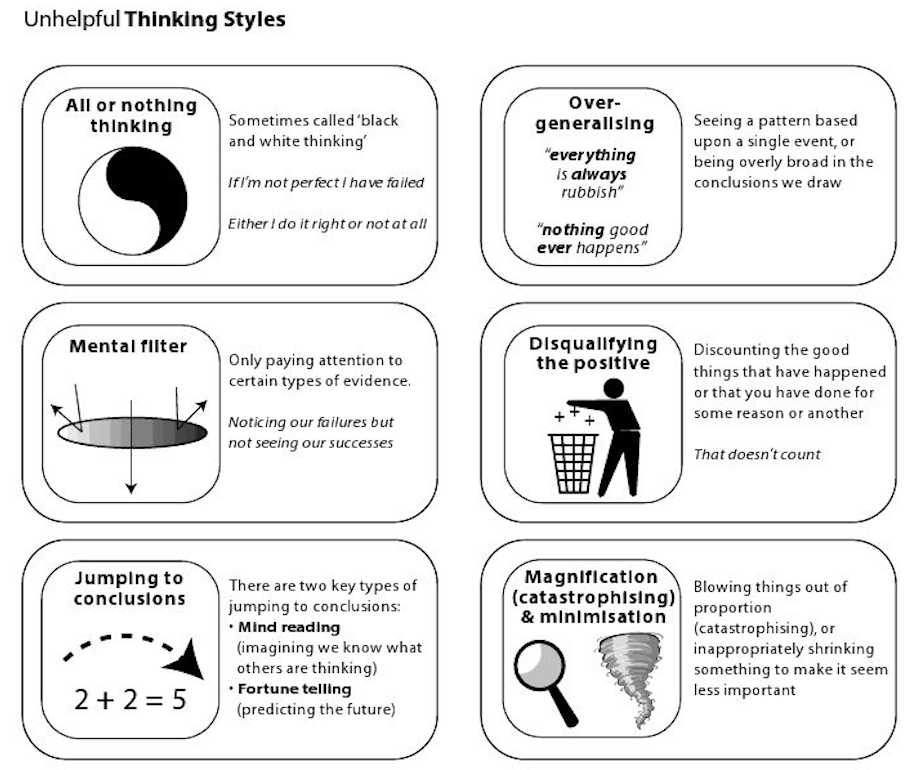
Unhelpful thinking styles (or cognitive distortions) from psychologytools.org
Black-and-White Thinking
Black-and-white thinking leaves no room for complexity. Something is either good or bad, right or wrong, a success or a failure.
In relationships, this can sound like:
“If they really cared, they wouldn’t have done this.”
“If I mess this up, it means I’m not good enough.”
This pattern often develops as a way to create certainty. The problem is that real life and real people are rarely that simple. When we loosen these extremes, we create space for growth, repair, and nuance.
Overgeneralization
Overgeneralization takes one moment and turns it into a rule.
Examples:
“This always happens to me.”
“I never say the right thing.”
The brain uses past pain to predict the future, even when the evidence is limited. One experience becomes a global conclusion about who you are or what to expect.
Mental Filter
A mental filter causes us to fixate on one negative detail while ignoring the rest of the picture.
For example, you might receive mostly positive feedback, but one critical comment becomes the only thing you can think about. The brain treats it as the most important data point, even if it’s not representative.
Over time, this can create a distorted sense of reality that feels far more negative than it actually is.
For many people, mental filters are closely tied to deeper core beliefs or long-standing narratives about themselves or others. If someone carries a belief like “I am unlovable,” moments of rejection or distance will stand out vividly, while moments of care are minimized or explained away. If the underlying narrative is “People can’t be trusted,” the brain will naturally scan for evidence of disappointment or betrayal and filter out experiences of reliability. For me personally, some of my harmful core beliefs are “I am too much” and “I am a bad person,” so I am extra sensitive to feedback or experiences that fit this narrative.
In this way, mental filters do not just shape what we notice. They quietly reinforce the stories we already believe to be true.
Disqualifying the Positive
Disqualifying the positive happens when good things are automatically dismissed.
Examples:
“They’re just being nice.”
“That doesn’t really count.”
This pattern often protects against disappointment, but it also prevents positive experiences from landing. Affirmation, success, and connection are filtered out before they can register.
Jumping to Conclusions
This includes mind reading and predicting the future without enough information.
Examples:
“They haven’t responded, so they must be upset with me.”
“This conversation is going to go badly.”
Our brains are excellent at creating stories, especially when uncertainty feels uncomfortable. Unfortunately, these stories are often convincing and wrong.
A Gentle Reframe
Interpretation-based thinking patterns are not about being irrational. They are about speed. Your brain is trying to protect you by filling in the blanks quickly.
The work is not to stop thoughts from appearing, but to slow them down just enough to ask, “What else might be true?”
In the next post, we’ll look at thinking patterns that impact self-worth and relationships more directly, especially the ones that shape how we see ourselves in connection with others.
Sources and Further Reading
The concepts in this post draw primarily from Cognitive Behavioral Therapy (CBT) and related cognitive models. The following resources are foundational and commonly referenced in both clinical practice and self-help contexts:
Beck, A. T. (1976). Cognitive Therapy and the Emotional Disorders. International Universities Press.
Beck, J. S. (2011). Cognitive Behavior Therapy: Basics and Beyond (2nd ed.). Guilford Press.
Burns, D. D. (1980). Feeling Good: The New Mood Therapy. HarperCollins.
Greenberger, D., & Padesky, C. A. (2016). Mind Over Mood (2nd ed.). Guilford Press.
• Beck, A. T., Freeman, A., & Davis, D. D. (2004). Cognitive Therapy of Personality Disorders (2nd ed.). Guilford Press.
